Rising Homelessness and Reduced Funding Prompt Housing Discussion in Lucas County
April 30, 2026
By Sarah Mokri
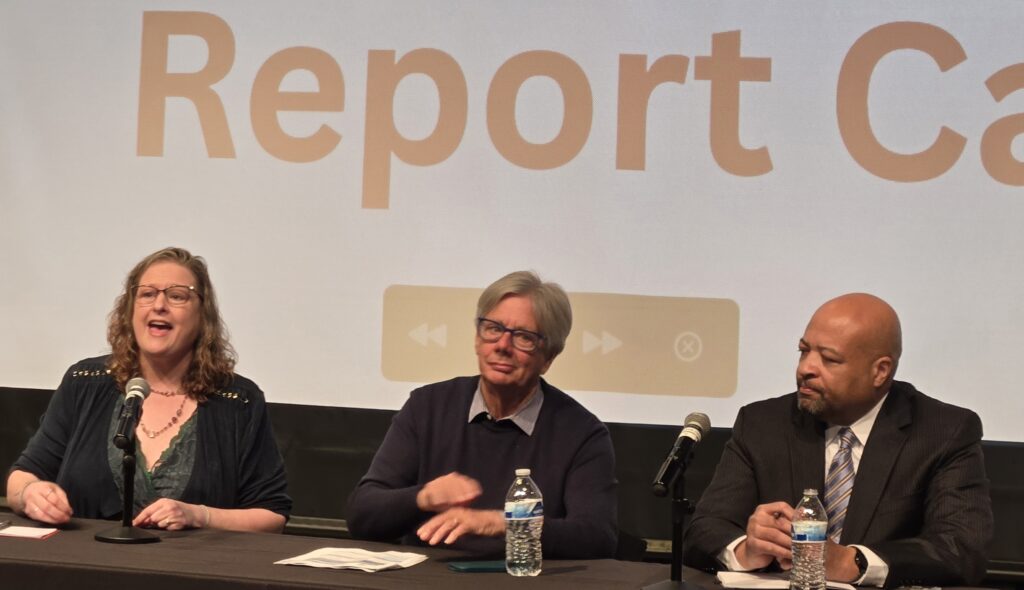
Lucas County and community leaders convened at the Maumee Indoor Theater on Wednesday night in a forum hosted by The League of Women Voters. The forum, open to the public, was centered on the challenges facing our county regarding affordable housing. Senghor Manns, President and CEO of Lucas Metropolitan Housing; Pete Gerken, Lucas County Commissioner; and Sandra De Steno, Director of 211 at United Way of Greater Toledo, participated in the roundtable discussion, which was moderated by 13 ABC News anchor Josh Croup.
“Half of Lucas County residents are renters,” Commissioner Pete Gerken noted.
Ohio has been consistently ranked among the top five most affordable housing markets in the US, and within Ohio, Toledo itself is ranked within the top five most affordable places to live. And yet, homelessness is increasing at an alarming rate. City-wide, there are 588 shelter beds which have been occupied at or near full capacity for the past several months. Toledo Public Schools estimates that 1,000 students are experiencing homelessness.
Ms. De Steno said that because of the very cold winter, United Way opened up warming shelters. “Sometimes it was 85 people a night on top of our other shelters. 85 people who are likely on the developmentally disabled spectrum. Older adults—I mean, the people who are being forced into homelessness at a very fast level are people who are over 60, [or] people with severe, persistent mental illness.”
With federal and state funding being reduced or eliminated on several fronts, officials only expect those numbers to get worse.
Federal Funding Becoming Limited
The reduction of federal and state funding was a large part of the discussion. With SNAP benefits being reduced or restricted and the Emergency Housing Voucher Program set to expire on June 30, 2026, housing authorities are having to find ways to work together with city and county leaders to help as many as possible with the funding they do receive.
The Low Cost of Housing is a “Blessing and a Curse”—Commissioner Gerken
Mr. Croup alluded to an editorial published in the Toledo Blade earlier this month that said, “the low cost of housing is an obstacle to renovating and building new housing.” Because the cost of new construction and renovation is trending higher, there’s little to no profit for investors if the rent payments don’t keep up with building costs. One of the solutions to this is to “put teams to work together to work through what those costs are going to be,” said Commissioner Gerken, referring to trade unions and community leaders.
Out-of-Town Investors
Panelists were in agreement that out-of-town investors can become a problem if they buy up property and let it sit until it’s completely dilapidated. In the case of the Greenbelt Place Apartments, the owner of the property lived in a million-dollar home in Austin, Texas. He rented the apartments out, but kept them in a state of disrepair until the City of Toledo stepped in, declared the property a nuisance, and notified HUD. While Greenbelt Place Apartments is a success story, Riverside Trailer Park is not. It was permanently closed when its out-of-town owner neglected it until it was deemed unfit for human habitation.
Good Jobs, Collaboration, and Poverty Programs Are the Key
In his most recent State of the City Address, Toledo Mayor Wade Kapszukiewicz said he would like the population of Toledo to grow to 300,000 by 2045, up from the roughly 265,000 current residents. To do so, the City plans on increasing housing, improving infrastructure, and creating jobs.
Mr. Manns said, “There are a number of different factors that attribute to the decision that’s made to construct in a particular jurisdiction… some of it is directly related to jobs, [and] the availability of livable wages being offered to the population.”
“It’s now up to $68,000 income a year to live here and not be overly burdened,” said Commissioner Gerken. “And that’s not everyone in Lucas County, so what’s the solution to that? To attract jobs, good living wage jobs. We don’t need jobs that pay $13 an hour. I’m sorry, that’s not an investment in the community.”
Good jobs are important, but so is inter-agency collaboration. Mr. Manns got candid, “I’ve been here for a year and a half… and one of the reasons I decided to come here—as I was doing research and I was speaking to a lot of the people around this area—is that I could feel and sense, and I heard that there was this element of collaboration that folks wanted to work… that they actually wanted to work together. I meet with folks from the City every month… I meet with the commissioners every month. I meet with the Land Bank every month… and we’re talking about how we can actually improve the City.”
Commissioner Gerken would like to see a poverty program in the county. “You don’t pay rent, maybe you get some support other than food stamps. That’s going away. Don’t pay rent because maybe you’ll get some childcare opportunities. That’s going away. The squeeze that’s coming in the next few months…. you know the way out of this? We need a poverty program. We need less poor people. I don’t want to be the agency that has the best poor people. I want no poor people.”
Meet Me In Maumee spoke with Commissioner Gerken after the event. He said he “looks forward to working with the City of Maumee administration, as he sees them as wanting to do good things, not only within Maumee but also the county.”
The mission of the League of Women Voters: “A nonpartisan political organization, encourages informed and active participation in government, works to increase understanding of major public policy issues, and influences public policy through education and advocacy.”